Pearson Edexcel · A-Level · English Literature
Course version: 9ET0 · Version from Sept 2015
Prose: use literary critical concepts and terminology with understanding…
Full specification wording
Component 2: Prose: use literary critical concepts and terminology with understanding and discrimination
Mastering A-Level prose requires students to apply literary critical concepts and terminology with both understanding and discrimination.
Checked against the Pearson Edexcel 9ET0 specification (opens in a new tab) on .
- Point 2 of 2
- 3 key terms
Study notes
From the checked teaching notes for this specification point.
The idea
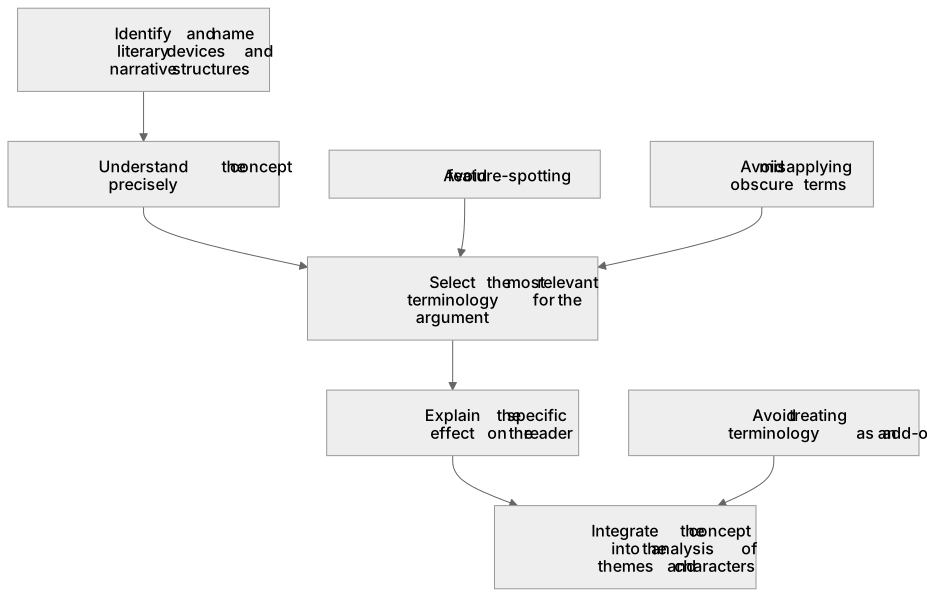
Mastering A-Level prose requires students to apply literary critical concepts and terminology with both understanding and discrimination. This means avoiding feature-spotting and instead selecting the precise term that illuminates the author's craft. Understanding involves knowing exactly what a concept like 'free indirect discourse' means. Discrimination requires choosing the most relevant terminology to support a specific argument, rather than listing techniques randomly. For instance, instead of vaguely noting that a writer uses 'good imagery', a discriminating student would identify a 'recurring motif of entrapment' and analyse how this specific critical concept reinforces the novel's overarching themes of social confinement.
What earns the marks
- Accurately identifying and naming specific literary devices and structural features used in the prose text.
- Applying broader critical concepts, such as narrative perspective, genre conventions, or theoretical frameworks.
- Demonstrating understanding by explaining the specific effect of the identified technique on the reader.
- Showing discrimination by selecting only the most relevant terminology that directly advances the essay's argument.
Common mistakes and how to put them right
Feature-spotting by listing literary terms without analysing their effect.
Put it right: Link the identified terminology to a specific analytical point about the author's purpose.
Using overly complex or incorrect terminology to sound academic.
Put it right: Prioritise clear understanding; use fundamental terms accurately rather than misapplying obscure concepts.
Treating terminology as an add-on rather than integral to the argument.
Put it right: Integrate critical concepts naturally into the evaluation of the text's themes and characters.
Exam tips
- Focus on structural and narrative terminology (like 'prolepsis' or 'omniscient narrator') which are highly relevant for prose analysis.
- Ensure every use of a literary term is followed by an exploration of its specific impact on the text's meaning.
- Avoid defining the terms in your essay; instead, demonstrate your understanding through your analysis of their effects.
Try the lesson
The start of the Component 2: Prose: use literary critical concepts and terminology with understanding and discrimination lesson, made from checked teaching notes for this specification point.
Have a go first
When analysing a modernist prose text, a student encounters a passage that abandons conventional punctuation to present the chaotic, unedited progression of a character's internal thoughts. Which literary critical concept best identifies this technique?
Listen
Mastering A-Level prose requires students to apply literary critical concepts and terminology with both understanding and discrimination. This means avoiding feature-spotting and instead selecting the precise term that illuminates the author's craft. Understanding involves knowing exactly what a concept like 'free indirect discourse' means. Discrimination requires choosing the most relevant terminology to support a specific argument, rather than listing techniques randomly. For instance, instead of vaguely noting that a writer uses 'good imagery', a discriminating student would identify a 'recurring motif of entrapment' and analyse how this specific critical concept reinforces the novel's overarching themes of social confinement. A strong answer earns marks for these points. Accurately identifying and naming specific literary devices and structural features used in the prose text. Applying broader critical concepts, such as narrative perspective, genre conventions, or theoretical frameworks. Demonstrating understanding by explaining the specific effect of the identified technique on the reader. Showing discrimination by selecting only the most relevant terminology that directly advances the essay's argument. A common slip: Feature-spotting by listing literary terms without analysing their effect. Instead, link the identified terminology to a specific analytical point about the author's purpose. Exam tip: Focus on structural and narrative terminology (like 'prolepsis' or 'omniscient narrator') which are highly relevant for prose analysis.
See it
Key words
Say what each word means before you turn the card.
Authorial methods
Try answering aloud or in your head before turning the card.
Analytical precision
Try answering aloud or in your head before turning the card.
Critical frameworks
Try answering aloud or in your head before turning the card.
See every definition
- Authorial methods
- The literary devices and structural features an author uses, which should be linked to a specific analytical point about the author's purpose.
- Analytical precision
- Selecting only the most relevant terminology that directly advances the essay's argument, rather than listing techniques randomly.
- Critical frameworks
- Broader critical concepts, such as narrative perspective, genre conventions or theoretical frameworks, applied with understanding and discrimination.
Label the diagram
Some boxes have lost their names. Pick the right name for each number.
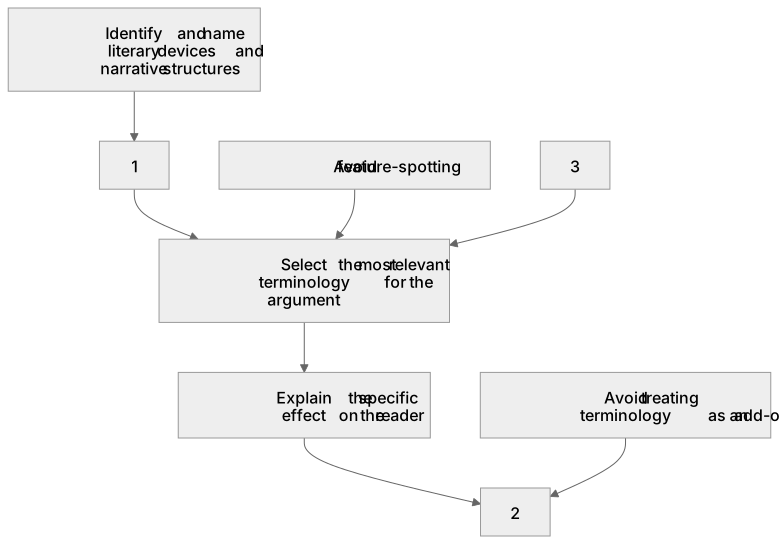
1Box 1
2Box 2
3Box 3
There is more to this lesson
The full lesson goes on to check your understanding and help you earn the marks. Create a free account to carry on, with your progress saved.
A week of Premium from your first lesson · Then the free plan continues · No card, no charge
Test your understanding of Component 2: Prose: use literary critical concepts and terminology with understanding and discrimination
Active recall beats re-reading. Take an instant quiz now to test what you’ve learned and lock it into long-term memory.
A week of Premium from your first lesson · Then the free plan continues · No card, no charge